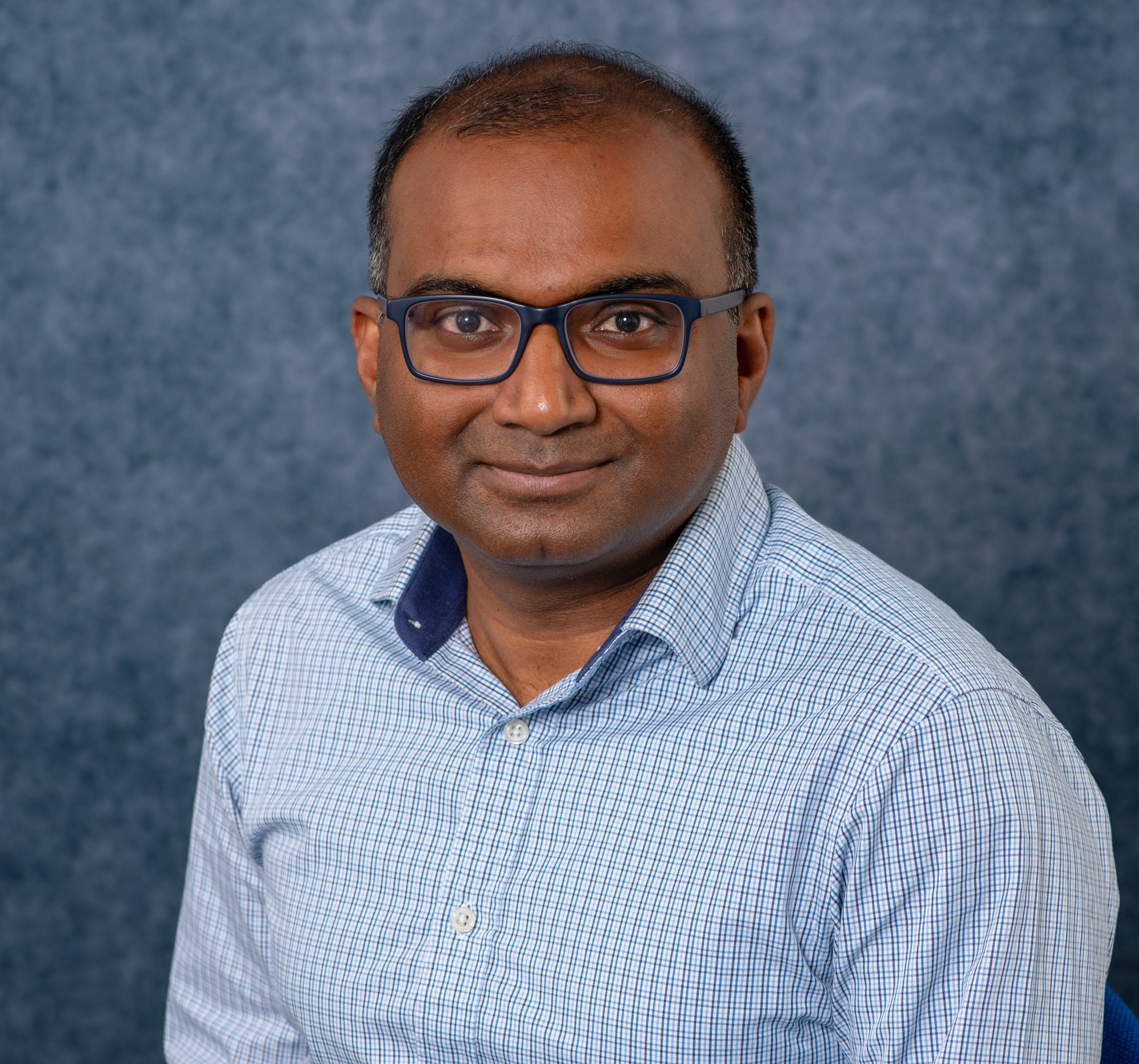
Dr. Saiful Khan is a Senior Computer Scientist at the Rutherford Appleton Laboratory, STFC, where he leads research and development of data-driven software infrastructure for large-scale scientific applications. He holds a DPhil (PhD) from the University of Oxford, where he conducted postdoctoral research under Prof. Min Chen. His work spans critical infrastructure including FAIR-MAST (nuclear fusion data), RAMPVIS (pandemic data visualization), SKA (radio astronomy), VBAS (seismological data visualization), DAFNI (national data & analytics infrastructure ), etc. With industry experience at Oracle, ABB, and other organizations, he bridges advanced research with real-world impact.
VIS4ML4HD: Visualization for Machine Learning for Human-centered Decision Making — Current AI/ML practice often focuses on selecting a single “best” model while discarding non-optimal alternatives. This leads to missed opportunities because we lack effective ways to understand models’ skill profiles, use them productively, or combine them meaningfully. Visualization can help address this challenge by leveraging the strengths of human visual perception to convey complex, high-volume information more efficiently than statistics or algorithms alone. It reduces cognitive load while preserving rich data context, enabling faster and more reliable reasoning. This project develops a visualization-enabled infrastructure and toolset that manages large pools of ML models and their performance profiles, supports the construction of effective model ensembles, and empowers decision makers to interpret model anomalies and reconcile conflicting predictions. Dr. Khan is a co-investigator and researcher on this EPSRC-funded project, conducted in collaboration with the University of Oxford.
Bridging the Gap: Correlative Imaging Across Length Scales — Understanding protein mechanisms in cancer progression requires integrating data across imaging scales and modalities. This UKRI-funded project combines AI/ML with advanced imaging to analyze patient biobank samples, developing automated workflows to accelerate discovery of mechanisms behind cancer progression and treatment resistance. Dr. Khan is a Co-Investigator of this project in collaboration with the Central Laser Facility (CLF), STFC.
DAFNI: Data & Analytics Facility for National Infrastructure — UK infrastructure research increasingly depends on modelling and analysis at unprecedented scale. DAFNI is a national computing platform that enables researchers to run advanced simulations across transport, water, energy, and city-scale systems, generating insights that help make infrastructure more efficient, reliable, resilient, and affordable. Dr. Khan serves as a user liaison and leads several initiatives on this project.
FAIR-MAST: Nuclear Fusion Data — Nuclear fusion experiments generate massive experimental datasets that remain inaccessible to modern data science methods. Dr. Khan, in collaboration with UK Atomic Energy Authority, led the development of FAIR-MAST for the Mega Ampere Spherical Tokamak (MAST), designing infrastructure that makes fusion data adhere to FAIR principles and open-sources it for visual analytics and AI/ML—the first comprehensive data management system of its kind in fusion research.
RAMP-VIS: Rapid Assistance in Modelling the Pandemic — During COVID-19, epidemiologists and modelling scientists required rapid, intuitive access to pandemic data and complex modelling outputs to make informed decisions. In response to the Royal Society’s Rapid Assistance in Modelling the Pandemic initiative (RAMP), Dr. Khan—working with the University of Oxford and the Scottish Covid Response Consortium (SCRC)—designed and developed RAMP-VIS, a visualization infrastructure that enabled SCRC scientists to efficiently analyse epidemiological data. For his contributions, he received the Royal Society’s RAMP Early Career Investigator Award.
SKA: Square Kilometre Array — The world's largest radio telescope, SKA, generates hundreds of TB/second of raw data, requiring real-time visualization at unprecedented scale. In his postdoctoral work at University of Oxford, Dr. Khan designed and implemented a visual analytics system with low-latency data streaming architecture and web-based rendering pipelines for high-volume real-time data streams.
VBAS: Visual Bulletin Analytics System — Seismologists at the International Seismological Centre (ISC) previously relied on inefficient, paper-based workflows to review complex seismic events across multiple data types. In his postdoctoral work at University of Oxford, Dr. Khan developed VBAS—an interactive visualization system that integrates diverse seismological data, including hypocentres, magnitudes, phase arrivals, travel-time curves, seismicity maps, station geometry, and more. VBAS provides a unified interface that helps ISC analysts detect patterns, identify anomalies, and perform data analysis far more efficiently. The system replaced the ISC’s 30-year-old paper-based process.
For other projects, please visit the projects section.
Oct 2025
Paper accepted at HiPC 2025Sept 2025
Paper presented at SCC 2025